Most people on Hyperliquid are making a directional bet. This strategy doesn't. It earns whether ETH goes up, down, or sideways, and it runs on one of the best perpetual venues in crypto.
This is not a zero-risk trade. The risks are different, not absent. Understand them before entering.
What delta neutral actually means
A delta neutral position is one where your net exposure to price movement is zero. If ETH goes up 20%, your gains on one leg cancel out your losses on the other. If it drops 20%, same thing in reverse. You're not betting on direction. You're structurally indifferent to it.
That might sound pointless. Why enter a trade that doesn't move when the asset moves? Because there's a separate yield source that has nothing to do with price: the funding rate.
The funding rate: your actual yield source
Perpetual futures have no expiry date. To keep the perp price tethered to spot, exchanges use a periodic payment called the funding rate. When the perp trades at a premium to spot (which happens most of the time in bull markets, when leveraged longs outnumber shorts): longs pay shorts. When it trades at a discount, the direction flips.
On most exchanges, funding settles every 8 hours. On Hyperliquid, it settles every hour. That higher frequency means your yield compounds faster, and also means the rate can shift faster. Both matter.
If you're net short on perps and funding is positive, you collect that payment each hour. That's the entire thesis. The basis trade is just a structured way to sit on the short side without taking directional risk on the asset.
The perp is trading above spot. Leveraged longs outnumber shorts. The market is paying you to hold the short side. Every hourly settlement lands in your account.
The perp is trading below spot. Shorts are overcrowded or sentiment has reversed. You're now paying each hour instead of collecting. The trade is working against you.
Paying $0.10/hr · $2.40/day · $72/month
Collecting $3.00/hr · $72.00/day · $2,160/month
BTC data: Hyperliquid snapshot, February 2026. Hypothetical scenario uses ETH bull market rates for illustration.
Open interest is the total notional value of all open perp positions on a market. High OI means a lot of capital is sitting in open leveraged trades. For this strategy, OI matters in two ways: first, high OI with positive funding confirms the market is long-heavy (longs outnumber shorts), which is exactly the setup you want as a short collecting funding. Second, a sharp drop in OI often signals mass liquidations or deleveraging, which can coincide with a funding rate reversal. Rising OI + positive funding is the ideal backdrop. Falling OI + funding turning negative is the exit signal.
What you can realistically earn
Funding rates change every hour. These projections assume a rate stays constant for the full period, which it won't. Use them as a rough calibration for different market environments, not a promise of return.
Portfolio size: $10,000 and $20,000. Based on hourly settlement on Hyperliquid. All figures are gross yield before any execution costs or borrow costs (leveraged version). Annualised figures assume the rate holds for 365 days.
| Hourly rate | Daily (annualised) | $10k daily | $10k monthly | $10k APY | $20k monthly | $20k APY |
|---|---|---|---|---|---|---|
| -0.0010% Exit signal Current BTC · Feb 2026 | -0.024% | -$2.40 | -$72 | -8.8% | -$144 | -8.8% |
| +0.0010% Low Quiet market, low conviction | +0.024% | +$2.40 | +$72 | +8.8% | +$144 | +8.8% |
| +0.0050% Moderate ETH / BTC in mild bull market | +0.12% | +$12.00 | +$360 | +43.8% | +$720 | +43.8% |
| +0.0100% Strong Active bull market, ETH / SOL | +0.24% | +$24.00 | +$720 | +87.6% | +$1,440 | +87.6% |
| +0.0300% Very high SOL / XRP during narrative cycle | +0.72% | +$72.00 | +$2,160 | +262.8% | +$4,320 | +262.8% |
| +0.0500% Spike Don't chase. Rate will compress. | +1.20% | +$120.00 | +$3,600 | +438% | +$7,200 | +438% |
These are theoretical projections assuming a fixed rate held for the full period. Real yield will be lower: rates fluctuate hourly, entries and exits create brief slippage, and the leveraged version subtracts borrow cost from every figure above. The moderate and strong rows (+0.005% to +0.01%) reflect realistic sustained conditions during active market cycles. The spike row (+0.05%) is shown for illustration; rates at that level almost always compress within hours.
Which markets to run this on
The top 10 markets by liquidity and volume on Hyperliquid are the cleanest venues for this strategy. Execution quality matters: a wide spread when entering or exiting the two legs creates temporary delta exposure that works against you.
For most positions, ETH and BTC are where you start. The funding is lower but the execution quality is higher, and a botched entry on a thin market erodes more of your yield than the premium funding compensates for.
You're in good company: protocols doing this at scale
The strategy you're running manually on Hyperliquid is structurally identical to what several major DeFi protocols have packaged into products. They've automated the entry, rebalancing, and exit, and distributed the yield as a token return. Understanding what they do clarifies exactly what you're doing.
Ethena's USDe is a synthetic dollar backed by spot crypto positions (primarily ETH, BTC, SOL, and BNB), each paired with an equivalent perp short. That's the delta neutral basis trade, packaged as a stablecoin. Holders of the staked version, sUSDe, receive the funding yield as APY. By late 2024, Ethena had become one of the largest stablecoins by TVL in DeFi.
The yield compressed in 2025 as funding rates normalised across the market, which is exactly the timing risk you're managing when you decide when to enter and exit.
Resolv uses the same delta neutral mechanics to back USR, its stablecoin. The structural difference is in how risk is layered: a leveraged tranche called RLP absorbs downside first, giving USR holders a more stable claim on the underlying yield. Same basis trade, split across two tranches by risk appetite.
The difference between running this yourself and using a protocol: protocols automate the entry, rebalancing, and exit, and charge a fee for doing it. When you run the strategy manually on Hyperliquid, you keep the full yield, carry the full risk, and do the monitoring yourself. Neither is wrong. They're different trade-offs for different situations.
The easy version: cash-and-carry basis trade
This is the cleanest implementation. Two legs, one chain, no borrowing. You're long the asset on spot and short the equivalent size on perps. Net delta zero. Funding flows to you as long as the rate stays positive.
Cash-and-Carry Basis Trade
Delta neutral: earn funding, not price direction
Two legs in, funding out. The entire structure in one view.
-
1
Check the funding rate before entering. Open Hyperliquid, navigate to the market you want, and check the current funding rate and recent history. A rate that's been positive for several consecutive periods is more meaningful than a single spike. You're looking for persistence, not size.
-
2
Buy the spot asset. On Hyperliquid's spot market (or any exchange with deep liquidity), buy the asset: ETH, BTC, SOL, or XRP. This is your long leg. Use a limit order to avoid slippage, especially on larger sizes.
-
3
Open an equal-sized perp short. On Hyperliquid's perp market, short the same asset at 1x leverage, matched as closely as possible in notional size to your spot position. Execute this immediately after the spot leg, as the time between the two creates temporary directional exposure.
-
4
Verify your net delta. Spot long + perp short of equal size = zero net exposure. A $10,000 spot long and a $10,000 perp short means a $1 move in ETH adds $10 on spot and loses $10 on perps, netting out to zero. Confirm this before walking away.
-
5
Collect funding, monitor the rate. Funding settles into your account every hour. The position is passive, but not set-and-forget. Check the funding rate periodically. If it flips negative and stays there, you're now paying instead of collecting. Know your exit before that happens, not after.
-
6
Unwind both legs simultaneously. When you exit, close the perp short and sell the spot position at the same time. Same logic as entry: time between the two legs creates delta exposure. Unwind clean.
Funding Rate: Illustrative Pattern
Rates vary by market and conditions. Check live on Hyperliquid.
Funding rate history: persistence matters more than the peak rate
Feeling adventurous: the leveraged basis trade
This version introduces borrowing cost and liquidation risk on the spot leg. The structure is the same, but leverage changes what can go wrong. Read the risk section before entering.
In the standard basis trade, your capital sits fully deployed in spot. The leveraged version uses margin on the spot leg to control a larger position with less capital. A larger spot position means a larger paired short, and more funding collected in absolute terms.
The math is more involved. Your net yield is no longer just the funding rate; it's the funding rate minus the borrowing cost on the spot leverage. When funding is high, the spread is attractive. When funding compresses, the borrowing cost can flip you from positive to negative carry without the asset price moving at all.
Leveraged Basis Trade
More funding captured, but two things can now liquidate you
Leveraged basis: two yield sources in tension, funding in and borrow cost out
-
1
Decide on your leverage multiplier. This determines how much spot you control per unit of capital. Higher leverage means more funding captured, but the liquidation threshold on the spot leg moves closer to the current price. Start conservative. The extra funding from high leverage rarely justifies the compression of your buffer.
-
2
Open the leveraged spot position. Use Hyperliquid's spot margin or a compatible lending protocol to establish the leveraged long. Note your effective borrow rate: this is the cost you're carrying that eats into funding income.
-
3
Open the matched perp short. Short the same notional size as your full leveraged spot exposure, not just your initial capital. A $5,000 deposit with 2x leverage means you're long $10,000 of spot, so your perp short should be $10,000 notional. Delta only nets to zero when the sizes actually match.
-
4
Understand what can liquidate you. This is the part most people skip. The spot leg and the perp leg are separate positions with separate margin and separate liquidation thresholds. A large enough price move can liquidate the spot leg even though the perp is hedging it, because they don't share margin. Know your spot liquidation price before you enter.
-
5
Monitor both carry and buffer. Check two things on a recurring basis: (1) Is funding still covering the borrow cost? (2) Is the spot position still safely above liquidation? Either can change independent of the other. Set alerts for both.
-
6
Unwind in sequence if needed. If you need to exit quickly, close the perp short first to release the hedge, then unwind the spot position. Closing spot first while the perp short remains open leaves you with a short-only position, directional exposure you didn't intend.
Risk analysis
The standard basis trade is a manageable strategy: the risks are real but bounded and mostly come down to monitoring. The leveraged version introduces meaningful new exposures that require active attention. Here's how the two compare across each dimension.
Risk comparison across five dimensions: standard vs. leveraged
The one thing most people get wrong
They enter when funding is at its peak, the exact moment it's most likely to mean-revert. A funding rate spike is usually a signal that the market is extremely one-sided, which often precedes a reversal in sentiment and a collapse in the rate. The trade works best when entered into sustained positive funding, not spikes.
The second mistake: treating it as passive. Funding rates move. Borrow costs move. Liquidation thresholds don't care that your other leg is hedging you. The position needs to be checked, not obsessively but regularly.
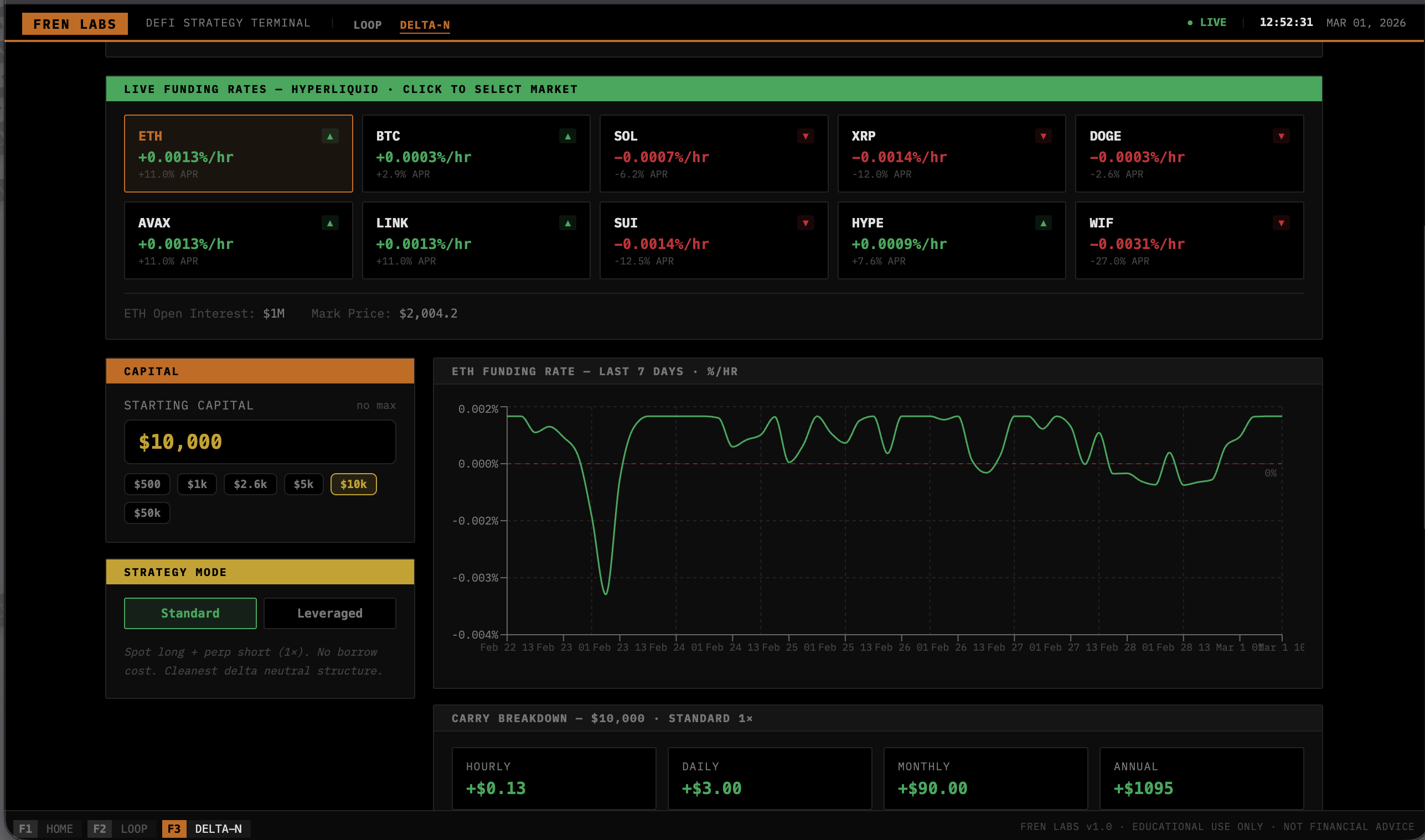
The numbers in this guide are modelled in real time on the Fren Labs Delta Neutral Explorer. Live funding rates from Hyperliquid across 10 markets, ranked position recommendations based on current conditions, carry breakdown by hour/day/month/year, and a liquidation stress test for the leveraged version.
Open Delta Neutral Explorer →Key takeaways
- Delta neutral means zero directional exposure. You profit from funding, not price movement
- Hyperliquid settles funding every hour, not every 8 hours. Rates compound faster and can shift faster
- ETH and BTC first: deepest liquidity, tightest entry/exit, most stable funding
- SOL, XRP, and smaller caps offer higher peak rates, with meaningfully higher rate volatility
- Enter into sustained positive funding, not spikes. Spikes are the signal the trade is crowded
- Standard version: risk is funding flipping negative. Know your exit before it happens
- Leveraged version: spot and perp legs have independent liquidation thresholds: the hedge does not protect against spot liquidation
- Net carry on the leveraged version = funding rate minus borrow cost. Both move independently
- Unwind both legs simultaneously on exit: time between legs creates the delta you built this to avoid
If you're curious how I think about products, systems, and trade-offs:
See how I think →